
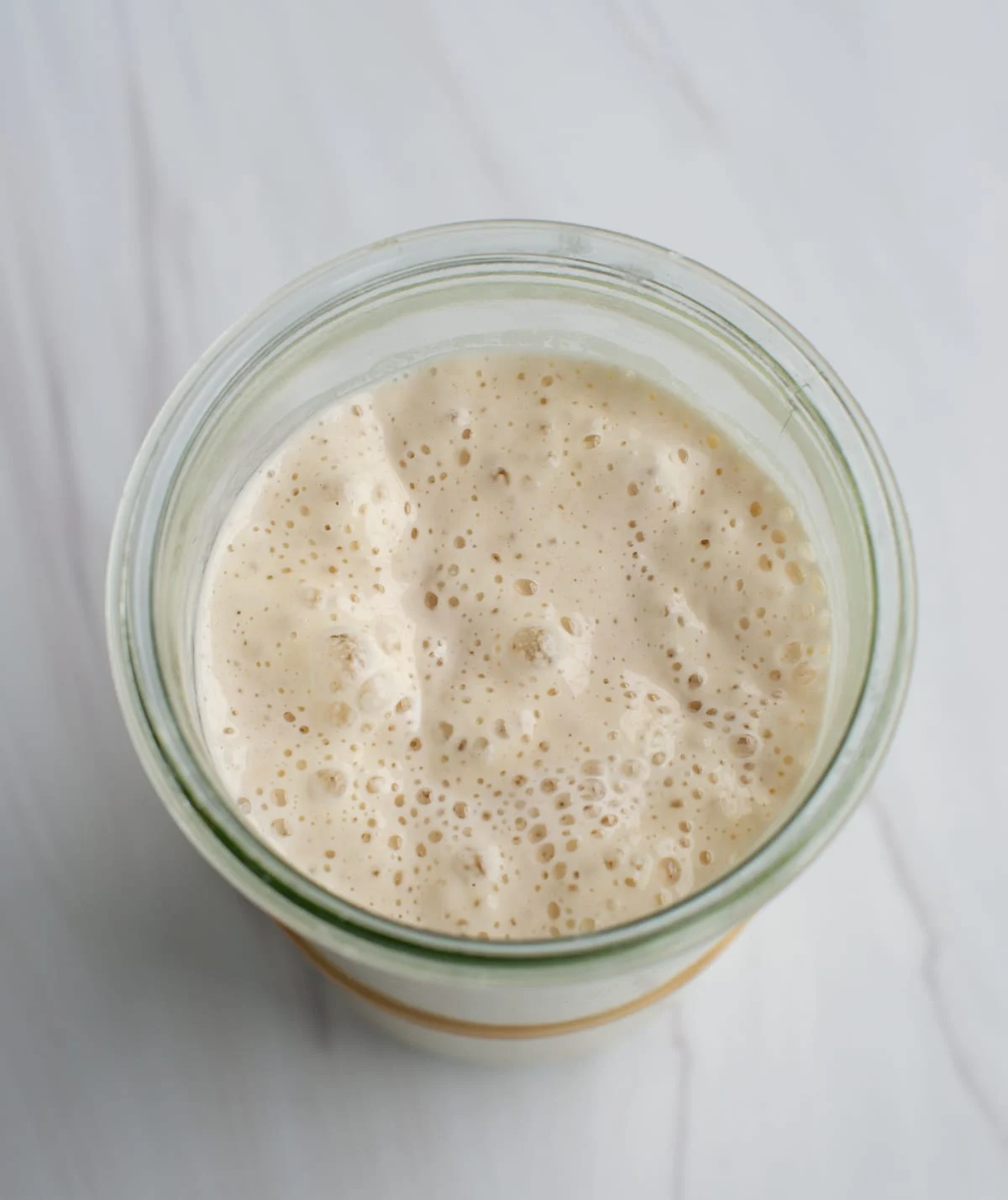
1. It Doubles in Size
The clearest sign of a healthy starter is that it doubles in volume within 4 to 8 hours after feeding (depending on room temperature).
Some strong starters may even triple in size.
2. It’s Full of Bubbles
A mature starter should have bubbles throughout—not just on the surface.
Look for:
- Small and large bubbles
- A light, airy texture
- A sponge-like interior
These bubbles are created by the wild yeast and beneficial bacteria producing carbon dioxide.
3. It Has a Pleasant Aroma
A ready starter should smell:
- Mildly tangy
- Slightly fruity
- Yogurt-like
- Fresh and yeasty
Avoid baking if your starter smells:
- Rotten
- Moldy
- Putrid
- Like spoiled food
A little acetone or alcohol smell usually means your starter is simply hungry and needs feeding.
4. It Passes the Peak Test
The best time to bake is when your starter has reached its highest point after feeding.
You’ll notice:
- The top is rounded or slightly domed.
- The starter has expanded to its maximum height.
- It’s still airy and fluffy.
Once it begins collapsing, it has passed its peak and becomes less active, though it can still often be used depending on the recipe.
5. It Floats (Optional Test)
The popular float test involves dropping a small spoonful of starter into room-temperature water.
If it floats, the starter contains plenty of trapped gas and is usually ready for baking.
However, this test isn’t always reliable. Some perfectly healthy starters sink because they were stirred, are made with whole-grain flour, or have already started to deflate. It’s best used alongside the other signs rather than as the only indicator.
How Old Should a Starter Be?
Most sourdough starters become reliable after 7 to 14 days of regular feeding.
The exact timing depends on:
- Room temperature
- Type of flour used
- Feeding schedule
- Water quality
Some starters mature faster, while others may need two or three weeks before they’re consistently strong enough for baking.
Best Time to Use Your Starter
For the strongest rise, use your starter:
- At its peak after feeding
- When it has doubled or tripled in size
- Before it begins collapsing
- While it’s full of bubbles and airy
If your kitchen is warm, the peak may come in 4–6 hours. In cooler kitchens, it may take 8–12 hours.
Simple Daily Readiness Check
Before mixing your dough, ask yourself:
- Has the starter doubled in size?
- Is it full of bubbles?
- Does it smell pleasantly tangy?
- Has it reached its highest point?
- Does it look light and airy?
If you can answer yes to these questions, your starter is ready to bake with.
Tips for a Strong, Active Starter
- Feed your starter on a regular schedule.
- Use filtered or dechlorinated water if possible.
- Keep it in a warm spot, ideally 75–80°F (24–27°C).
- Use a kitchen scale for consistent feeding ratios.
- Don’t rush a young starter—it becomes stronger with time and regular feedings.
- Mark the starter’s level with a rubber band or piece of tape after feeding to easily see how much it has risen.
Common Mistakes to Avoid
- Using the starter immediately after feeding instead of waiting for it to peak.
- Baking with a starter that hasn’t doubled in size.
- Ignoring signs of a weak or sluggish starter.
- Overfeeding or underfeeding the starter.
- Storing a new starter in a cold environment where fermentation slows significantly.
Final Thoughts
A sourdough starter is ready to use when it is active, bubbly, has doubled or tripled in size after feeding, smells pleasantly tangy, and has reached its peak rise. Paying attention to these visual and aromatic cues is more reliable than relying on a single test, such as the float test.
Once your starter consistently shows these signs, you’ll be well on your way to baking flavorful, well-risen sourdough bread with confidence.
