
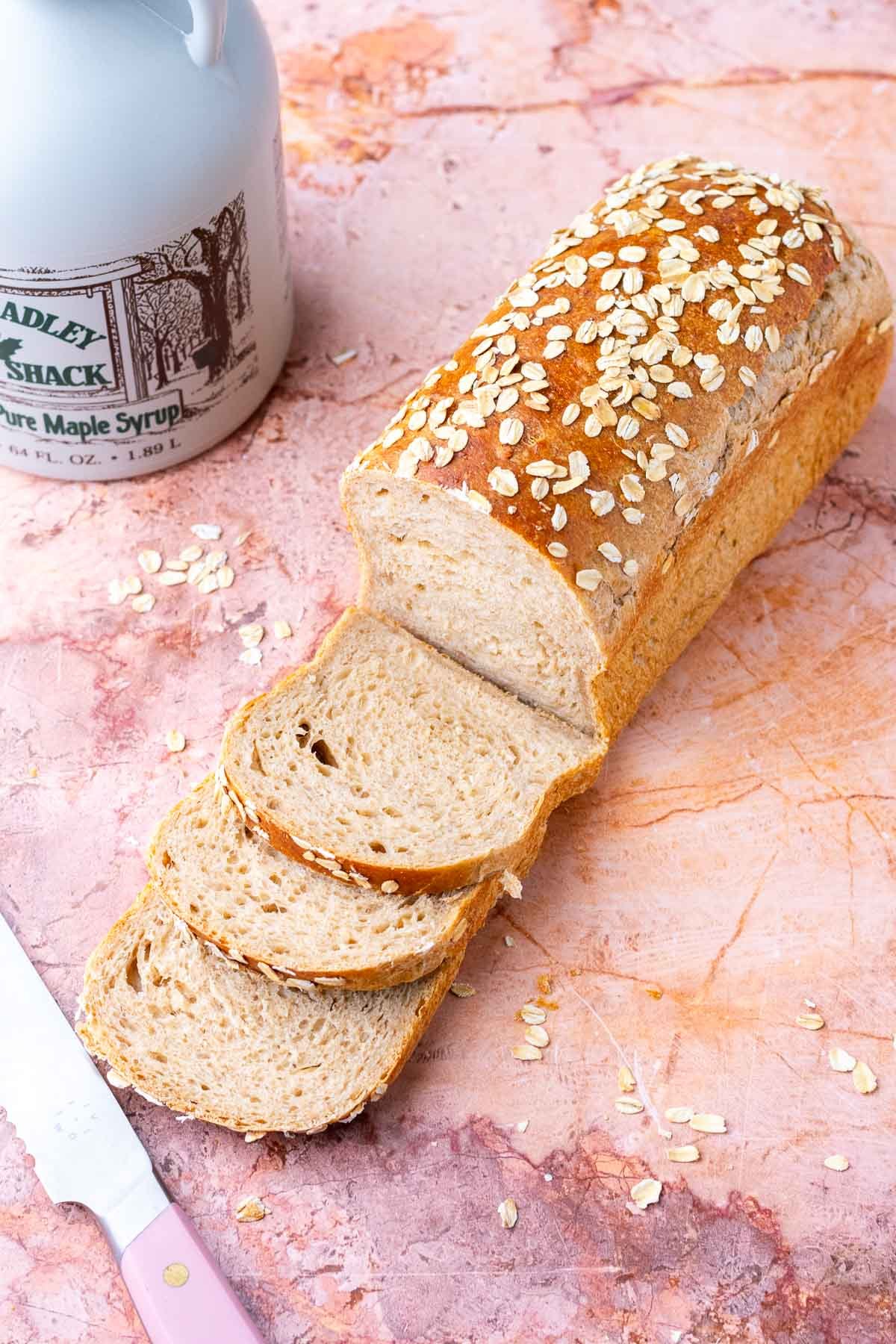
Prep Time: 30 minutes
Fermentation Time: 8–14 hours
Bake Time: 35–45 minutes
Difficulty: Intermediate
Yield: 1 large sandwich loaf (9×5 inch loaf pan)
Ingredients
For the Dough
- 100 g active sourdough starter (100% hydration)
- 400 g bread flour
- 100 g rolled oats
- 300 g water, room temperature
- 80 g whole milk
- 60 g pure maple syrup
- 30 g unsalted butter, softened (or olive oil)
- 10 g fine sea salt
For the Oat Topping
- 2–3 tablespoons rolled oats
- 1 tablespoon milk or water for brushing the dough
Instructions
Step 1: Prepare the Oats
Place the rolled oats in a bowl and pour about 50 g of the recipe water over them. Allow them to soak for 20–30 minutes.
Soaking the oats helps soften their texture, allowing them to absorb moisture and blend smoothly into the dough. This creates a softer sandwich bread instead of a dry or crumbly loaf.
Step 2: Mix the Dough
In a large mixing bowl, combine the bread flour, soaked oats, sourdough starter, remaining water, milk, maple syrup, softened butter, and salt.
Mix until all ingredients are fully combined and no dry flour remains.
The dough will feel slightly sticky because of the oats and maple syrup. This is normal and will become smoother as gluten develops.
Cover the bowl and let the dough rest for 30 minutes.
Step 3: Develop the Dough
After resting, perform a series of stretch-and-folds.
To stretch and fold:
- Grab one side of the dough.
- Stretch it upward gently.
- Fold it over the center.
- Rotate the bowl and repeat.
Perform 3–4 sets of folds, about 30 minutes apart.
This strengthens the dough structure and helps create a soft, airy sandwich bread texture.
Step 4: Bulk Fermentation
Cover the dough and let it ferment at room temperature for 4–6 hours, depending on the strength of your starter and kitchen temperature.
The dough should become smoother, slightly expanded, and show signs of fermentation such as bubbles around the edges.
For improved flavor, you can refrigerate the dough overnight after bulk fermentation.
Step 5: Shape the Loaf
Lightly grease a 9×5 inch loaf pan.
Turn the dough onto a lightly floured surface and gently shape it into a rectangle.
Fold the dough into thirds like a letter, then roll it tightly into a loaf shape. Pinch the seam closed and place the dough seam-side down into the prepared pan.
Brush the top lightly with milk or water and sprinkle with rolled oats.
Step 6: Final Proof
Cover the loaf and allow it to rise until it reaches about 2–3 cm above the edge of the loaf pan.
This usually takes 2–5 hours depending on room temperature and starter activity.
The dough should look puffy and feel soft when gently pressed.
Step 7: Bake the Bread
Preheat the oven to 190°C (375°F).
Bake the loaf for 35–45 minutes until the top is golden brown and the bread sounds hollow when tapped.
If the top browns too quickly, cover it loosely with foil during the final 10 minutes of baking.
For the softest sandwich texture, brush the warm crust with a little butter immediately after baking.
Step 8: Cool Before Slicing
Remove the bread from the pan and allow it to cool completely on a wire rack before slicing.
Cutting while warm can compress the crumb and make the slices appear gummy. Cooling allows the loaf structure to finish setting.
Tips for the Best Maple Oat Sourdough Bread
Use a Strong Starter
A lively sourdough starter is key to achieving a soft, well-risen loaf. Your starter should be bubbly, active, and recently fed before mixing the dough.
Do Not Skip Soaking the Oats
Soaking prevents the oats from pulling too much moisture from the dough and helps maintain a tender crumb.
Measure Ingredients by Weight
Bread baking is more consistent when ingredients are measured using grams rather than cups, especially for sourdough recipes.
Adjust Fermentation Time
Sourdough fermentation depends on temperature. A warm kitchen may require less time, while a cooler environment may need longer.
Variations
Maple Cinnamon Oat Bread
Add:
- 1 teaspoon cinnamon
- 2 tablespoons raisins
for a sweet breakfast-style loaf.
Seeded Maple Oat Bread
Add:
- 2 tablespoons sunflower seeds
- 2 tablespoons pumpkin seeds
- 1 tablespoon flax seeds
for extra texture and nutrition.
Honey Oat Sourdough Bread
Replace maple syrup with honey for a slightly different sweetness and flavor.
Storage Instructions
Store the cooled loaf in an airtight container or bread bag at room temperature for up to 4 days.
For longer storage, slice the bread and freeze it for up to 3 months. Toast slices directly from frozen whenever needed.
Serving Suggestions
- Classic sandwiches with cheese, vegetables, or spreads
- Toast topped with butter and maple syrup
- Breakfast toast with peanut butter and banana
- Avocado toast
- French toast
- Grilled cheese sandwiches
Frequently Asked Questions
Can I make this bread without a loaf pan?
Yes. The dough can be shaped into a free-form round loaf and baked on a baking stone or sheet pan, although the loaf will have a more rustic shape.
Can I use quick oats instead of rolled oats?
Rolled oats are recommended because they provide better texture, but quick oats can work if that is what you have available.
Why is my sourdough sandwich bread dense?
Dense bread is usually caused by an inactive starter, insufficient fermentation, or under-proofing. Make sure your starter is strong and allow enough time for the dough to rise.
Can I make this dairy-free?
Yes. Replace milk with a plant-based milk and butter with olive oil or a dairy-free butter alternative.
Final Thoughts
Maple Oat Sourdough Sandwich Bread is the perfect balance of wholesome ingredients, natural fermentation, and everyday comfort. With its soft texture, gentle maple sweetness, and hearty oat flavor, this loaf turns simple sandwiches and toast into something truly special.
Once you make this homemade sourdough sandwich bread, it may become your favorite everyday loaf for breakfast, lunch, and everything in between.
