
Ingredients
Day 1
- ½ cup (60g) whole wheat flour or unbleached all-purpose flour
- ¼ cup (60ml) filtered or non-chlorinated water
Days 2–7
- ½ cup (60g) unbleached all-purpose flour
- ¼ cup (60ml) filtered or non-chlorinated water
Equipment
- 1 quart (1-liter) glass jar
- Kitchen scale (recommended for accuracy)
- Wooden spoon or silicone spatula
- Loose-fitting lid or clean cloth
- Rubber band or marker (to track growth)
Instructions
Day 1: Mix the Starter
In a clean glass jar, combine the flour and water.
Stir until no dry flour remains and the mixture resembles a thick pancake batter.
Scrape down the sides of the jar.
Cover loosely with a lid or clean cloth and leave at room temperature (70–75°F / 21–24°C) for 24 hours.
Day 2: First Feeding
You may notice a few bubbles or little activity.
Discard about half of the starter.
Add:
- ½ cup (60g) flour
- ¼ cup (60ml) water
Mix thoroughly, cover loosely, and let it rest for another 24 hours.
Day 3
More bubbles may appear, and the starter may begin to smell fruity or slightly sour.
Discard half of the starter.
Feed with:
- ½ cup (60g) flour
- ¼ cup (60ml) water
Mix well and leave at room temperature.
Day 4
The starter should begin rising more consistently after each feeding.
Repeat the process:
- Discard half.
- Feed with fresh flour and water.
- Mix thoroughly.
- Cover loosely.
Allow it to ferment for another 24 hours.
Day 5
Your starter should now have a pleasant tangy aroma with plenty of bubbles.
Discard half again.
Feed with:
- ½ cup (60g) flour
- ¼ cup (60ml) water
Mark the level with a rubber band to monitor how much it rises.
Day 6
Continue feeding every 24 hours.
If your kitchen is warm and the starter is doubling in size within 6–8 hours, you may begin feeding every 12 hours to strengthen it.
The starter should now be airy, bubbly, and elastic.
Day 7
Your sourdough starter is ready when it:
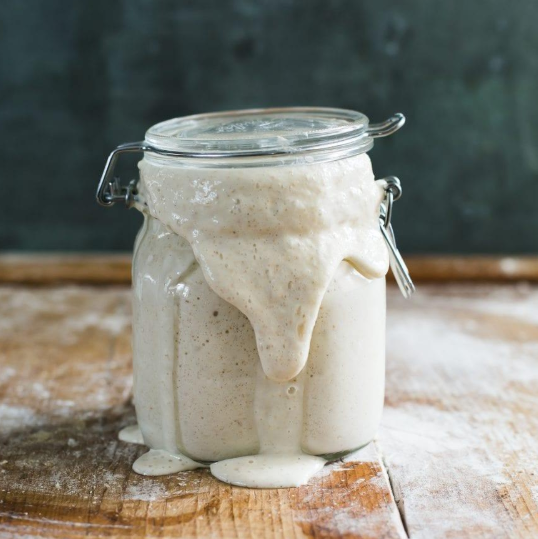
- Doubles in size within 4–8 hours after feeding.
- Has plenty of bubbles throughout.
- Smells pleasantly tangy and slightly fruity.
- Passes the rise test consistently.
It is now ready for baking.
How to Feed an Established Starter
If stored at room temperature:
- Feed every 24 hours.
If stored in the refrigerator:
- Feed once a week.
To feed:
- Discard all but about ½ cup (100g) starter.
- Add ½ cup (60g) flour and ¼ cup (60ml) water.
- Stir until smooth.
Let it sit at room temperature for several hours before returning it to the refrigerator.
Tips
- Use filtered or non-chlorinated water for the best fermentation.
- Whole wheat flour often helps the starter become active more quickly during the first few days.
- Keep the starter in a warm location between 70–75°F (21–24°C).
- Use a clean jar and utensils to avoid contamination.
- Stir well during each feeding to evenly distribute the yeast and bacteria.
- If liquid (called hooch) forms on top, stir it in or pour it off before feeding.
- A pleasantly sour, fruity aroma is normal; foul or moldy odors mean the starter should be discarded.
Variations
Whole Wheat Starter
Feed exclusively with whole wheat flour for a hearty, nutty flavor.
Rye Sourdough Starter
Use whole rye flour to encourage rapid fermentation and a robust sour taste.
Bread Flour Starter
Maintain the starter with bread flour for extra strength and gluten development.
Mixed Flour Starter
Alternate between whole wheat, rye, and all-purpose flour to build a flavorful, resilient culture.
Gluten-Free Starter
Use gluten-free flour blends such as brown rice or buckwheat flour for gluten-free sourdough baking.
Storage
Room Temperature: Feed every 24 hours if baking frequently.
Refrigerator: Store in a loosely covered jar and feed once every 7 days.
Freezer: Freeze a well-fed starter in an airtight container for up to 3 months. Thaw completely and feed several times before baking.
Dry Storage: Spread a thin layer of active starter on parchment paper, allow it to dry completely, then crumble and store in an airtight container for up to 1 year. Rehydrate with water and flour when ready to use.
Serving Suggestions
Use your active sourdough starter to make:
- Artisan sourdough bread
- Sandwich bread
- Pizza dough
- Bagels
- English muffins
- Pancakes
- Waffles
- Cinnamon rolls
- Crackers
- Pretzels
- Dinner rolls
- Focaccia
Nutrition (Per Tablespoon of Active Starter)
- Calories: 15
- Carbohydrates: 3g
- Protein: 1g
- Fat: 0g
- Saturated Fat: 0g
- Cholesterol: 0mg
- Sodium: 0mg
- Fiber: 0g
- Sugar: 0g
Conclusion
A homemade Sourdough Starter is the foundation of flavorful, naturally fermented baking. With just flour, water, and a little patience, you’ll create a thriving culture that can be used to bake everything from artisan bread to pancakes and pizza. Once established, a well-maintained starter can last for years, rewarding you with delicious homemade sourdough whenever inspiration strikes.
