
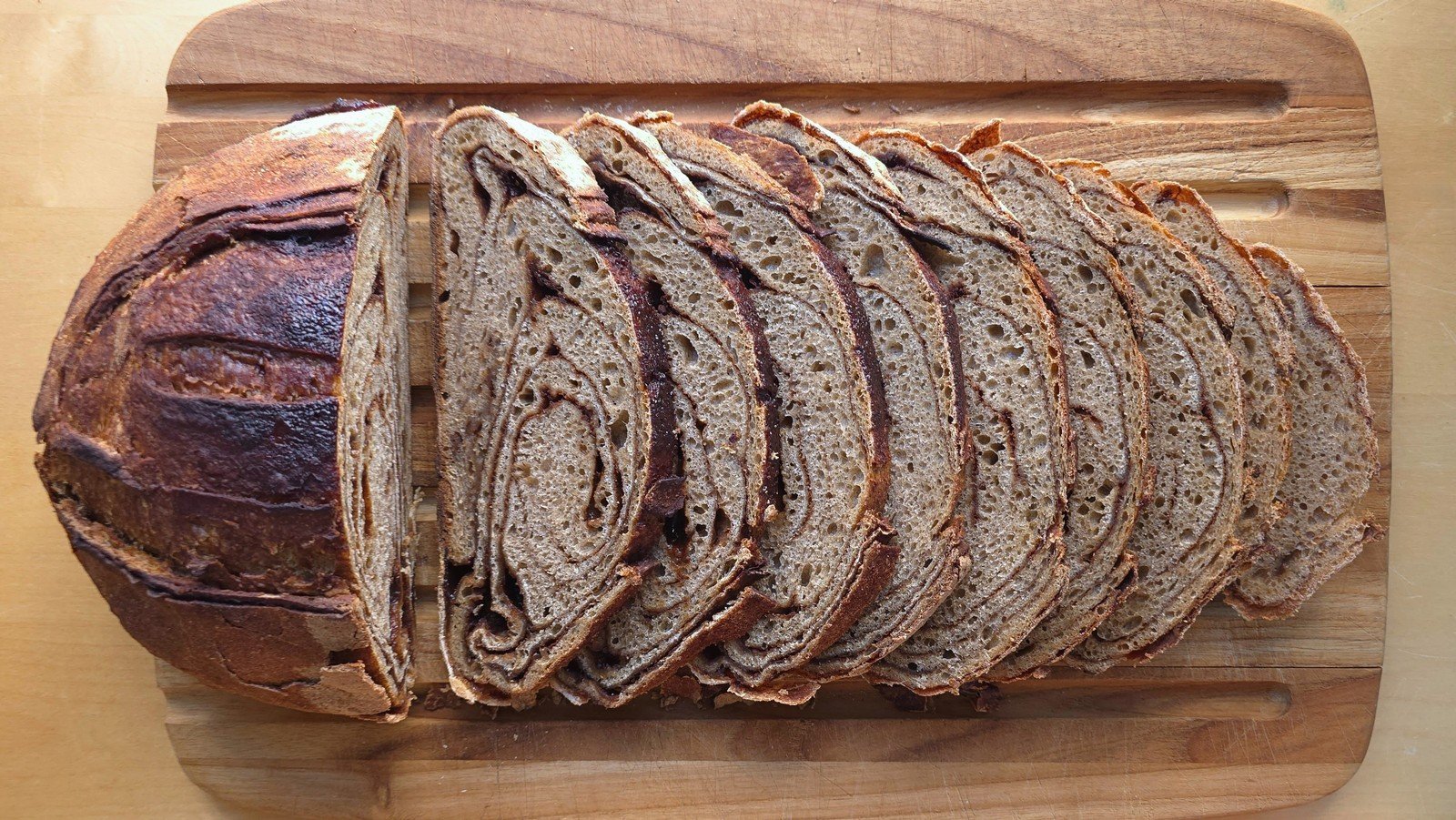
Cinnamon Roll Sourdough Bread Recipe
Yield
1 large loaf (10–12 servings)
Prep Time
45 minutes
Bulk Fermentation
8–10 hours
Second Rise
2–3 hours
Bake Time
40–45 minutes
Total Time
11–14 hours
Ingredients
For the Sourdough Dough
- 1 cup (225g) active sourdough starter (100% hydration)
- ¾ cup (180ml) whole milk, room temperature
- 2 large eggs, room temperature
- ¼ cup (50g) granulated sugar
- ¼ cup (57g) unsalted butter, softened
- 4 cups (480g) bread flour
- 1½ teaspoons salt
For the Cinnamon Sugar Filling
- ½ cup (113g) unsalted butter, softened
- 1 cup (200g) brown sugar
- 2 tablespoons ground cinnamon
- 1 teaspoon vanilla extract
- ¼ teaspoon nutmeg (optional)
For the Vanilla Glaze
- 1½ cups (180g) powdered sugar
- 3 tablespoons milk or heavy cream
- 1 teaspoon vanilla extract
- Pinch of salt
Equipment Needed
- Large mixing bowl
- Stand mixer (optional)
- Rolling pin
- Bench scraper
- 9×5-inch loaf pan
- Plastic wrap or kitchen towel
- Cooling rack
Instructions
Step 1: Feed Your Starter
About 4–6 hours before mixing the dough, feed your sourdough starter.
The starter is ready when:
- It has doubled in size.
- It looks bubbly throughout.
- A spoonful floats in water.
Using an active starter is essential for a light and fluffy loaf.
Step 2: Mix the Dough
In a large bowl, whisk together:
- Active sourdough starter
- Milk
- Eggs
- Sugar
Mix until smooth.
Add:
- Bread flour
- Salt
Mix until a shaggy dough forms.
Add the softened butter one tablespoon at a time, kneading after each addition until fully incorporated.
The dough may feel sticky at first but will become smooth as you knead.
Step 3: Knead the Dough
Knead by hand for 10–12 minutes or with a stand mixer for 8–10 minutes.
The dough should become:
- Smooth
- Elastic
- Slightly tacky
Perform a windowpane test by stretching a small piece of dough. It should stretch thin enough to see light through it without tearing.
Step 4: Bulk Fermentation
Place the dough in a lightly greased bowl.
Cover and let ferment at room temperature for 8–10 hours or until doubled in size.
The exact timing depends on:
- Starter strength
- Room temperature
- Humidity
A warm kitchen may require less time.
Step 5: Prepare the Cinnamon Filling
In a medium bowl combine:
- Brown sugar
- Cinnamon
- Nutmeg (if using)
Mix well.
In a separate bowl, stir together:
- Softened butter
- Vanilla extract
until creamy and spreadable.
Step 6: Roll Out the Dough
Lightly flour your work surface.
Turn the dough out onto the counter and gently press out excess air.
Roll into a rectangle measuring approximately:
18 x 12 inches (45 x 30 cm)
Try to keep the thickness even throughout.
Step 7: Add the Filling
Spread the softened butter mixture evenly over the dough, leaving a ½-inch border around the edges.
Sprinkle the cinnamon sugar mixture evenly across the butter layer.
Gently press the filling into the dough to help it adhere.
Step 8: Roll and Shape
Starting with the long side, roll the dough tightly into a log.
Pinch the seam closed.
Using a sharp knife, cut the log lengthwise down the center, exposing the cinnamon layers.
Twist the two strands together, keeping the cut sides facing upward.
This creates the beautiful cinnamon swirl effect.
Step 9: Pan the Loaf
Grease a 9×5-inch loaf pan.
Carefully transfer the twisted dough into the pan.
Tuck the ends underneath if necessary.
Cover loosely with plastic wrap or a clean kitchen towel.
Step 10: Second Rise
Allow the loaf to rise for 2–3 hours.
The dough should become noticeably puffy and rise close to the top of the pan.
Do not rush this step.
A proper second rise ensures a soft and airy texture.
Step 11: Bake
Preheat oven to:
350°F (175°C)
Bake for 40–45 minutes.
The loaf should be:
- Deep golden brown
- Fully risen
- Fragrant with cinnamon
Internal temperature should reach:
190–200°F (88–93°C)
If the top browns too quickly, tent loosely with aluminum foil during the final 15 minutes.
Step 12: Cool
Remove the bread from the pan.
Place on a cooling rack.
Allow to cool for at least 20–30 minutes before glazing.
Step 13: Make the Vanilla Glaze
In a small bowl whisk together:
- Powdered sugar
- Milk or cream
- Vanilla extract
- Pinch of salt
Mix until smooth and pourable.
Adjust consistency with additional milk if needed.
Step 14: Glaze and Serve
Drizzle the glaze generously over the warm bread.
Allow it to set for a few minutes.
Slice and enjoy while slightly warm for the ultimate cinnamon roll experience.
Storage
Room Temperature
Store in an airtight container for up to 3 days.
Refrigerator
Store up to 1 week.
Freezer
Wrap tightly and freeze for up to 3 months.
Thaw overnight and warm before serving.
Variations
Cream Cheese Frosting
Replace the glaze with cream cheese frosting for a true cinnamon roll flavor.
Raisin Cinnamon Bread
Add 1 cup raisins to the filling.
Maple Pecan Version
Add chopped pecans and use maple syrup in the glaze.
Apple Cinnamon Bread
Spread finely diced cooked apples over the filling before rolling.
Baker’s Tips
- Use bread flour for the softest texture and best rise.
- Keep the dough slightly tacky rather than adding too much flour.
- Roll the dough tightly to create defined swirls.
- An overnight refrigerator proof can deepen the sourdough flavor.
- Warm slices for 10–15 seconds in the microwave before serving.
