
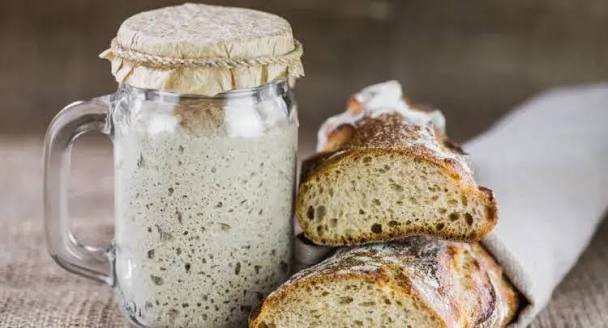
Ingredients
Day 1
- 60g whole wheat flour
- 60g filtered water (room temperature)
Daily Feedings (Days 2–14)
- 60g flour
- 60g water
Recommended Flour Blend
For the strongest starter:
- 50% whole wheat flour
- 50% unbleached bread flour
Equipment
- Large glass jar (1-liter capacity)
- Kitchen scale
- Spoon or spatula
- Rubber band or marker
- Loose-fitting lid or cloth cover
Why Make a Sourdough Starter?
A mature sourdough starter:
- Replaces commercial yeast
- Develops natural flavor
- Improves bread texture
- Enhances keeping quality
- Creates artisan-style bread at home
- Can last indefinitely with proper care
Many sourdough starters are passed down for years and even decades.
Day 1: Create the Starter
In a clean glass jar combine:
- 60g whole wheat flour
- 60g room-temperature water
Mix thoroughly until no dry flour remains.
The mixture should resemble a thick pancake batter.
Scrape down the sides of the jar.
Loosely cover and leave at room temperature (70–78°F / 21–26°C) for 24 hours.
Mark the starting level with a rubber band.
Day 2: First Feeding
You may notice:
- A few bubbles
- Mild aroma
- Little or no growth
This is normal.
Discard all but 60g of starter.
Add:
- 60g flour
- 60g water
Mix thoroughly.
Cover loosely and let rest another 24 hours.
Day 3: Activity Begins
The starter may:
- Smell slightly sour
- Produce more bubbles
- Rise and fall
Again, discard all but 60g.
Feed with:
- 60g flour
- 60g water
Mix well and cover.
At this stage, the starter often appears very active before slowing down again. This is a normal part of microbial development.
Day 4: The Quiet Phase
Many beginners think their starter has died.
Common signs:
- Fewer bubbles
- Little rise
- Strange smell
Do not worry.
Continue the feeding schedule:
Discard to 60g starter and add:
- 60g flour
- 60g water
The beneficial yeast and bacteria are still establishing themselves.
Days 5–7: Strength Building
You should begin seeing:
- Consistent bubbles
- Pleasant sour aroma
- Noticeable rise after feeding
Feed every 24 hours:
- Keep 60g starter
- Add 60g flour
- Add 60g water
If your kitchen is warm, consider feeding twice daily.
Days 8–14: Maturation
The starter becomes stronger each day.
A mature starter should:
- Double or triple in volume
- Rise predictably
- Smell pleasantly tangy
- Have a light, airy texture
Continue regular feedings.
Most starters become bake-ready between days 7 and 14.
How to Know Your Starter Is Ready
A healthy starter should:
✅ Double in size within 4–8 hours
✅ Contain many bubbles throughout
✅ Smell fresh, tangy, and slightly fruity
✅ Have a light, airy consistency
✅ Pass the rise test consistently
The Float Test (Optional)
Fill a glass with water.
Drop a small spoonful of starter into the water.
If it floats, it usually contains enough trapped gas to leaven bread.
However, the rise test is a more reliable indicator than the float test.
Feeding Schedule for Maintenance
Room Temperature Storage
Feed every 24 hours:
- 50g starter
- 50g flour
- 50g water
Refrigerator Storage
Feed once weekly:
- Remove from refrigerator.
- Discard excess.
- Feed.
- Allow to sit at room temperature for 2–4 hours.
- Return to refrigerator.
How to Use Your Starter
Before baking:
- Feed your starter.
- Allow it to peak.
- Use when doubled or tripled in size.
This usually takes:
- 4–8 hours in a warm kitchen
- 8–12 hours in a cooler kitchen
Common Problems and Solutions
Starter Smells Like Nail Polish
This means it is hungry.
Solution:
- Feed more often
- Increase feeding ratio
Liquid on Top (Hooch)
A gray liquid may form.
This is normal.
Simply pour it off or stir it in before feeding.
No Bubbles
Possible causes:
- Cold temperature
- Chlorinated water
- Weak flour
Move starter to a warmer spot and continue feeding.
Mold Growth
If pink, orange, or fuzzy mold appears:
Discard immediately and start over.
Best Temperature for Growth
Ideal range:
- 75–80°F (24–27°C)
Warmer temperatures encourage faster fermentation and stronger activity.
Sourdough Starter Discard Ideas
Don’t throw away your discard!
Use it for:
- Pancakes
- Waffles
- Crackers
- Pizza dough
- Biscuits
- Muffins
- Pretzels
- Flatbreads
- Banana bread
- Cinnamon rolls
Storage
A well-maintained sourdough starter can live indefinitely.
Many famous bakery starters are decades old and become stronger with regular feeding and use.
Baker’s Tips for Success
- Use filtered water whenever possible.
- Weigh ingredients for accuracy.
- Feed at the same time each day.
- Keep the jar clean.
- Use whole wheat flour during the first week for faster development.
- Be patient—every starter develops at its own pace.
Nutritional Benefits
Natural sourdough fermentation may help:
- Improve digestibility
- Enhance flavor
- Increase mineral availability
- Extend shelf life of baked goods
- Reduce reliance on commercial yeast
A thriving sourdough starter is the foundation of incredible homemade bread. With just flour, water, and a little patience, you’ll create a living culture that can produce delicious artisan loaves, pizza crusts, rolls, and pastries for years to come. Happy baking!
