
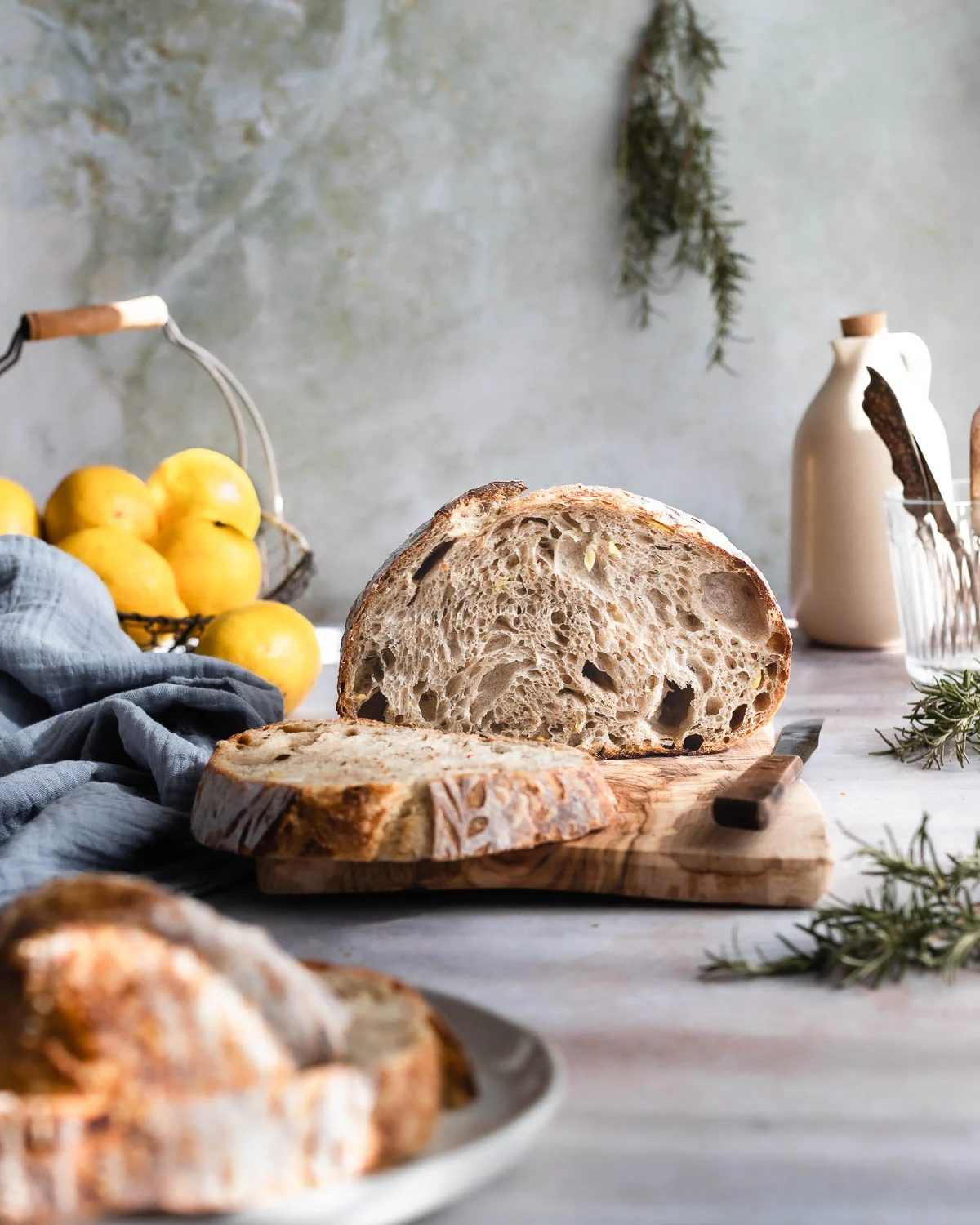
Ingredients
For the Dough
- 100g active sourdough starter (100% hydration)
- 375g filtered water, room temperature
- 500g bread flour
- 10g fine sea salt
- 2 tablespoons fresh rosemary, finely chopped
- Zest of 2 large lemons
- 1 tablespoon fresh lemon juice
Optional Add-Ins
- 1 teaspoon dried thyme
- 2 tablespoons olive oil
- 1 tablespoon honey
For Dusting
- Rice flour
- Bread flour
Understanding the Ingredients
Sourdough Starter
A healthy, active starter is the foundation of excellent sourdough bread. The starter should be bubbly, doubled in size, and at its peak activity before mixing the dough.
Rosemary
Fresh rosemary contributes a woodsy, aromatic flavor that becomes even more pronounced during baking.
Lemon
Fresh lemon zest contains fragrant oils that infuse the loaf with bright citrus notes without adding excess moisture.
Bread Flour
Higher protein content helps create strong gluten development and a chewy artisan texture.
Equipment Needed
- Large mixing bowl
- Digital kitchen scale
- Dough scraper
- Banneton basket
- Dutch oven
- Parchment paper
- Sharp lame or bread scoring knife
- Cooling rack
Step 1: Feed Your Starter
Approximately 4–6 hours before mixing your dough, feed your sourdough starter.
A healthy starter should:
- Double in size
- Be filled with bubbles
- Smell pleasantly tangy
- Float in water when tested
Using starter at peak activity helps ensure excellent fermentation and oven spring.
Step 2: Mix the Dough
In a large mixing bowl combine:
- 100g active sourdough starter
- 375g water
Whisk until the starter dissolves.
Add:
- 500g bread flour
Mix thoroughly until all flour is hydrated.
The dough will appear shaggy and rough.
Cover the bowl with a damp towel.
Allow the dough to rest for 45–60 minutes.
This stage is called the autolyse.
During this time:
- Flour absorbs water
- Gluten begins forming naturally
- Dough becomes easier to handle later
Step 3: Add Salt and Flavorings
After the autolyse, add:
- 10g sea salt
- Chopped rosemary
- Lemon zest
- Lemon juice
Mix thoroughly by squeezing and folding the dough.
Continue mixing until all ingredients are evenly distributed.
You should immediately notice the wonderful aroma of fresh herbs and citrus.
The dough may feel slightly sticky due to the lemon juice.
This is completely normal.
Step 4: Strengthen the Dough
Over the next 2 hours perform a series of stretch-and-folds.
First Stretch and Fold
Wet your hands.
Lift one side of the dough.
Stretch upward without tearing.
Fold over itself.
Rotate the bowl.
Repeat on all four sides.
Cover and rest 30 minutes.
Repeat Three More Times
Perform a total of four stretch-and-fold sessions.
With each fold:
- Dough becomes smoother
- Structure strengthens
- Air begins developing inside
By the final fold the dough should hold its shape much better.
Step 5: Bulk Fermentation
Cover the bowl.
Allow the dough to ferment at room temperature for 4–6 hours.
The exact time depends on temperature.
Signs Bulk Fermentation is Complete
- Dough increases by 50–75%
- Surface appears domed
- Air bubbles become visible
- Dough feels light and airy
Avoid over-fermenting, which can weaken the dough structure.
Step 6: Pre-Shape the Dough
Lightly flour your work surface.
Gently turn out the dough.
Using a bench scraper, form the dough into a loose round shape.
Avoid pressing out too much air.
Cover and allow the dough to rest for 20–30 minutes.
This rest period helps relax the gluten before final shaping.
Step 7: Final Shaping
Lightly flour the top of the dough.
Flip it over.
Stretch the edges inward toward the center.
Create surface tension by rotating and tightening the loaf.
A properly shaped loaf should feel firm and hold its shape.
Place the dough seam-side up into a floured banneton basket.
Step 8: Overnight Cold Fermentation
Cover the basket.
Place in the refrigerator for 8–16 hours.
This slow fermentation:
- Improves flavor
- Creates better texture
- Enhances oven spring
- Develops deeper sourdough complexity
Meanwhile, the rosemary and lemon continue infusing throughout the dough.
Step 9: Preheat the Oven
The next day place your Dutch oven inside the oven.
Preheat to:
475°F (245°C)
Allow at least 45 minutes of preheating.
A thoroughly heated Dutch oven is crucial for maximum oven spring.
Step 10: Prepare for Baking
Remove dough from the refrigerator.
Turn onto parchment paper.
Dust lightly with flour.
Using a bread lame, score the surface.
Popular scoring patterns include:
- Single slash
- Leaf design
- Wheat stalk pattern
- Cross hatch design
Scoring controls expansion during baking.
Step 11: Bake the Bread
Carefully lower the dough into the hot Dutch oven.
Cover with the lid.
Bake for:
25 minutes covered
The trapped steam helps create a thin, crisp crust.
Remove the lid.
Reduce temperature to:
450°F (232°C)
Bake an additional:
20–25 minutes uncovered
The crust should become:
- Deep golden brown
- Crisp and crackly
- Richly caramelized
Internal temperature should reach:
208–210°F (98–99°C)
Step 12: Cool Completely
Transfer the loaf to a cooling rack.
Allow to cool for at least:
1–2 hours
Cooling allows the crumb to finish setting.
Slicing too early may result in a gummy texture.
What Makes This Bread Special?
Unlike plain sourdough, this loaf delivers multiple layers of flavor:
Rosemary
Adds earthy, savory notes.
Lemon Zest
Provides fresh citrus brightness.
Natural Fermentation
Creates complexity and tanginess.
Artisan Crust
Offers satisfying crunch and texture.
Together they create a loaf that tastes like it came from a specialty artisan bakery.
Serving Ideas
This bread pairs beautifully with:
- Garlic herb butter
- Olive oil and balsamic vinegar
- Roasted chicken
- Tomato soup
- Seafood chowder
- Goat cheese
- Brie cheese
- Smoked salmon
- Grilled vegetables
- Mediterranean platters
It also makes exceptional:
- Grilled cheese sandwiches
- Avocado toast
- Breakfast toast
- Gourmet paninis
Storage Tips
Room Temperature
Store in a bread bag or wrapped in a clean towel for up to 4 days.
Freezer
Slice before freezing and store up to 3 months.
Reheating
Warm slices in a toaster or oven at 350°F (175°C) for 5 minutes.
Final Thoughts
Rustic Rosemary Lemon Sourdough Bread combines the timeless charm of artisan sourdough with the fresh flavors of rosemary and lemon. Its crisp crust, airy crumb, and aromatic flavor make it a memorable loaf that works equally well for everyday meals and special occasions. The slow fermentation process creates a bread that is not only delicious but also deeply satisfying to bake from scratch. Every slice delivers a perfect balance of tangy sourdough, fragrant herbs, and bright citrus notes.
