
Ingredients
For the Dough
- 150g active sourdough starter
- 350g warm water
- 300g bread flour
- 200g rye flour
- 12g fine sea salt
- 1 tablespoon honey or malt syrup
- 1 teaspoon caraway seeds (optional)
- 1 teaspoon fennel seeds (optional)
For Dusting
- Rye flour or all-purpose flour
Instructions
Step 1: Mix the Dough
In a large mixing bowl, combine the active sourdough starter, warm water, and honey.
Stir until the starter is dissolved.
Add the bread flour, rye flour, salt, and optional seeds.
Mix until all ingredients are incorporated and a sticky dough forms.
Cover the bowl and let rest for 30 minutes.
Step 2: Develop the Dough
Because rye flour contains less gluten than wheat flour, the dough will be stickier than traditional sourdough.
Perform three sets of stretch-and-folds every 30 minutes:
- Wet your hands.
- Lift one side of the dough.
- Fold it toward the center.
- Rotate the bowl and repeat.
The dough will become smoother but remain somewhat sticky.
Step 3: Bulk Fermentation
Cover the bowl and allow the dough to ferment at room temperature for 4–6 hours.
The dough should expand noticeably and show small air bubbles throughout.
Step 4: Shape the Loaf
Lightly flour a work surface with rye flour.
Turn out the dough and gently shape it into a round or oval loaf.
Avoid overworking the dough, as rye dough is more delicate than wheat dough.
Place the loaf seam-side up in a floured proofing basket.
Step 5: Final Proof
Cover the basket and refrigerate overnight for 12–16 hours.
This extended proof develops the characteristic flavor and improves crust formation.
Step 6: Preheat the Oven
Place a Dutch oven or baking stone in the oven.
Preheat to 250°C (480°F) for at least 45 minutes.
A hot baking environment is essential for proper oven spring.
Step 7: Score the Dough
Turn the dough onto parchment paper.
Dust lightly with rye flour.
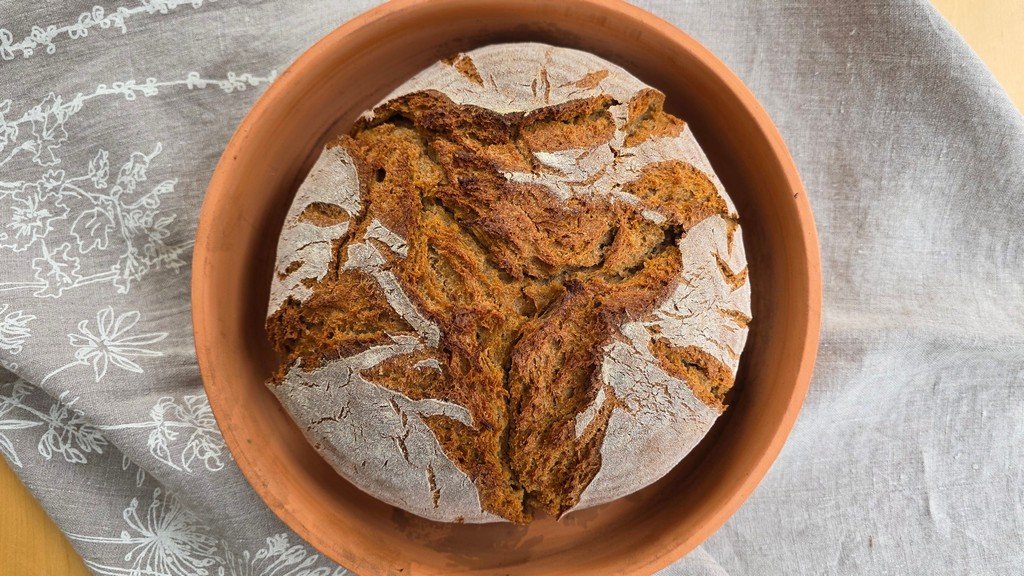
Using a sharp razor blade or bread lame, score a large cross or a single long slash across the top.
Traditional Bauernbrot often features a rustic cross-shaped score.
Step 8: Bake
Transfer the loaf into the hot Dutch oven.
Bake covered for 20 minutes.
Reduce the temperature to 230°C (450°F).
Remove the lid and continue baking for 25–30 minutes until the crust becomes dark golden brown and crisp.
The internal temperature should reach approximately 96°C (205°F).
Step 9: Cool Completely
Place the bread on a wire rack and allow it to cool for at least 2 hours.
Rye breads continue to set as they cool, so patience is important for the best texture.
Tips for Perfect Bauernbrot
Use Fresh Rye Flour
Fresh rye flour delivers the most authentic flavor and aroma.
Don’t Expect a High Rise
Rye breads are naturally denser than white sourdough loaves.
Wet Hands Help
Rye dough can be sticky, so damp hands make handling much easier.
Try Traditional Seeds
Caraway and fennel seeds add classic German bakery flavor.
Allow Full Cooling Time
The crumb develops fully as the loaf cools.
Serving Suggestions
- Spread with butter and honey
- Serve alongside soups and stews
- Pair with smoked meats and cheeses
- Use for open-faced sandwiches
- Enjoy toasted with fruit preserves
Storage
- Store in a bread box or paper bag for up to 5 days.
- Freeze whole or sliced for up to 3 months.
- Refresh by warming in a 180°C (350°F) oven for 5–10 minutes.
Nutrition Information (Approximate Per Slice)
- Calories: 180
- Carbohydrates: 35g
- Protein: 6g
- Fat: 1.5g
- Fiber: 4g
- Sodium: 220mg
